


Foothill vs. Valley: Why Excavation Is Different in the Placer County Foothills


You bought the foothill lot for the oaks, the slope, and the view. Those same three things are why your excavation bid looks nothing like your friend's flat lot down in Roseville.
Here's the short version. Once you leave the valley floor, four things change at the same time: the ground under your feet, the way water moves across it, the rules the county applies, and the plain work of getting equipment to the site. Each one moves your cost and your timeline. Understand them before you break ground and you avoid the surprises that wreck foothill budgets.
Davidson Excavation works these hills every week. Jacob Davidson walks every site before he quotes it, because in the foothills what you can't see is usually what costs you. Here's what actually changes above the valley floor.
The ground: rock and decomposed granite, not valley loam
On the valley floor you're mostly digging soft, deep loam. Up here the ground is a mix of clay, decomposed granite, and solid rock, and it doesn't announce itself. We routinely hit rock a few feet down on lots a seller swore were "all dirt."
Rock changes everything downstream. It slows the dig, it can force a different method like ripping or breaking instead of straight excavation, and it changes where a septic field or a foundation can actually sit. An excavator who quotes your lot like flat farmland is guessing. The honest move is to test for rock and plan around it, not price it out and hand you a change order later.
The slope: cut, fill, and building a pad on a grade
A valley home sits on a flat pad you can nearly drive onto. A foothill home sits on a pad you have to build. That means cutting into the high side, filling and compacting the low side, and sometimes adding a retaining wall or benching the slope so the pad holds.
Get the cut and fill wrong and you pay for it twice, once when the pad settles and again when the drainage fails. Getting it right is engineered site work, coordinated with your soils engineer and matched to the approved drawings so the inspector signs off the first time.
The septic: foothill lots usually need an engineered
system
This is the number that floors people. Across much of the Placer foothills, the county rarely approves a standard conventional septic system, because the soils and slopes don't pass the way flat valley ground does. So instead of a basic tank and leach field, you're often looking at an engineered or alternative design.
Plan on ranges, not a flat rate. An engineered system such as a sand filter tends to start around $20,000 installed. Advanced treatment systems like AdvanTex typically run $50,000 and up. The driver isn't the contractor, it's the perc test, the soils, the slope, and the design the county requires. That's also why a septic bid on a foothill lot can be triple a valley quote for the same house.
The rules: Placer County's 2025 septic update and permit gates
Foothill projects run through more permit gates than valley builds, and the rules move. In October 2025, Placer County updated its Local Agency Management Program, the framework that governs how septic systems get designed, permitted, and installed here. A contractor working off last year's assumptions can cost you a permit round.
Septic isn't the only gate. Foothill lots often trigger grading permits and tree permits that flat parcels never touch. Knowing which one applies before the first machine shows up is the difference between a schedule that moves and one that stalls.
Not Sure What Your Foothill Lot Actually Needs?Jacob walks every site before he quotes it, including rock, slope, septic, and access. No guessing and no surprise change orders. |
The water: drainage and erosion behave differently on a slope
On flat ground, water mostly sits and soaks. On a grade it runs, and it takes your driveway, your topsoil, and your pad with it if the site isn't shaped for it. Foothill site prep has to plan where every winter storm goes, using swales, French drains, and grading that carries water away from the house.
Skip that step and the first wet Placer winter finds the shortcut. Washed-out gravel driveways and eroded pads are some of the most common repair calls we get, and nearly all of them trace back to drainage that was an afterthought.
The access: getting equipment up a foothill road
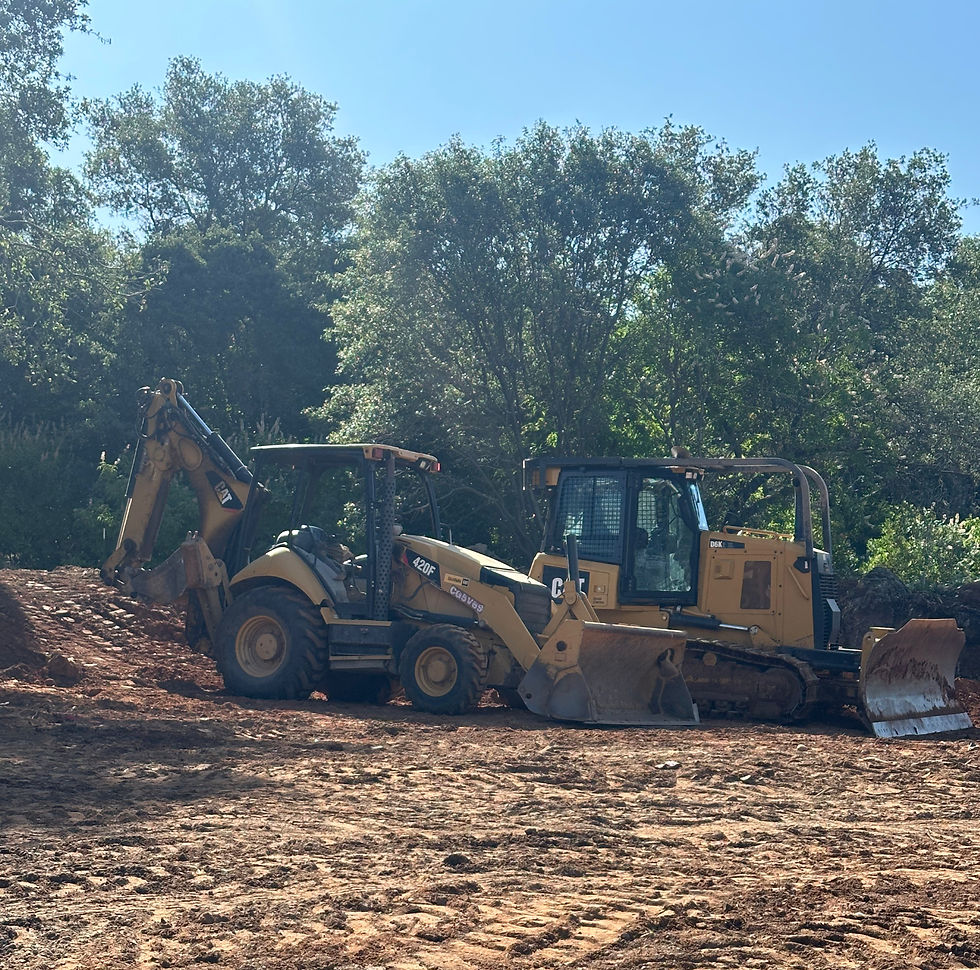
None of the work above matters if the machine can't reach it. Foothill lots come with narrow roads, tight switchbacks, gates, and long haul distances that a valley job never deals with. That shapes which equipment fits, how material gets staged, and how many days the job takes.
It's an unglamorous difference, but it's a real line item, and it's one more reason a bid built for flat, open access comes in low and finishes high.
Why a foothill specialist beats the lowest valley bid
Put it together and the pattern is clear. Foothill dirt work is a coordination problem, not just a digging problem. The ground, the water, the county rules, and the access all interact, and the person quoting your job needs to have seen how they interact before.
That's the case for hiring local. Jacob runs the equipment and walks the site himself, coordinates with your septic designer and your builder, and bids the foothill reality instead of the valley version of it. Taking the lowest valley bid on a foothill lot is one of the most common ways we watch a budget blow up, because the surprises land after the contract is signed.
Get an Estimate Built for Foothill GroundReal numbers for rock, slope, and engineered septic instead of a valley bid that finishes high. |
Foothill excavation FAQ
Why is excavation more expensive in the foothills than the valley? Rock, slope, engineered septic, extra permits, and harder site access each add cost that a flat valley lot never sees. The house can be identical; the site work is not.
Do I need a perc test and an engineered septic system? On most Placer foothill lots, yes. The county rarely approves conventional systems here, so plan for a perc test and an engineered or alternative design.
What is a building pad, and why does a sloped lot need cut and fill? A pad is the flat, compacted base your home sits on. On a slope you build it by cutting the high side and filling and compacting the low side so it holds and drains.
Do I need a grading or tree permit in Placer County? Often. Foothill lots frequently trigger grading and tree permits that flat parcels don't. Confirm which gates apply before you break ground.
Get an estimate built for foothill ground
If you're staring at a raw foothill lot, or a septic bid that doesn't add up, talk to someone who works these hills every week. Get a free estimate or call Jacob directly, and get numbers built for foothill ground instead of valley ground.

Comments